An Interactive Replication
The Rise of Fiscal Capacity
How a bureaucratic innovation transformed hundreds of medieval territories into the foundations of modern European states
Based on Cantoni, Mohr & Weigand · Econometrica, 2024
A Patchwork of Princes
In 1400, the Holy Roman Empire contained roughly 300 territories. Prince-bishoprics, free cities, margravates, landgraviates, and a menagerie of feudal arrangements shared a common emperor but little else. Each levied its own tolls, minted its own coins, and bickered with its neighbours over grazing rights and river crossings.
The emperor could request contributions from the Imperial Diet. He could not compel them. When Maximilian I tried to impose a universal tax in 1495, the estates resisted. The resulting compromise was so convoluted that most territories ignored it.
In 1425, Frederick the Warlike of Saxony pawned the entire Vogtland to the Bohemian crown for 12,000 florins to pay for his war against the Hussites. A territory’s solvency often hinged less on fiscal systems than on the prince’s latest military gamble.
Blaschke, Sachsen im Zeitalter der Reformation (1970)This fragmentation had real consequences. Without reliable revenue, a prince could not maintain a standing army, employ judges, or survey his own roads. Governance remained improvised, and the gap between well-run territories and poorly-run ones widened with each generation.
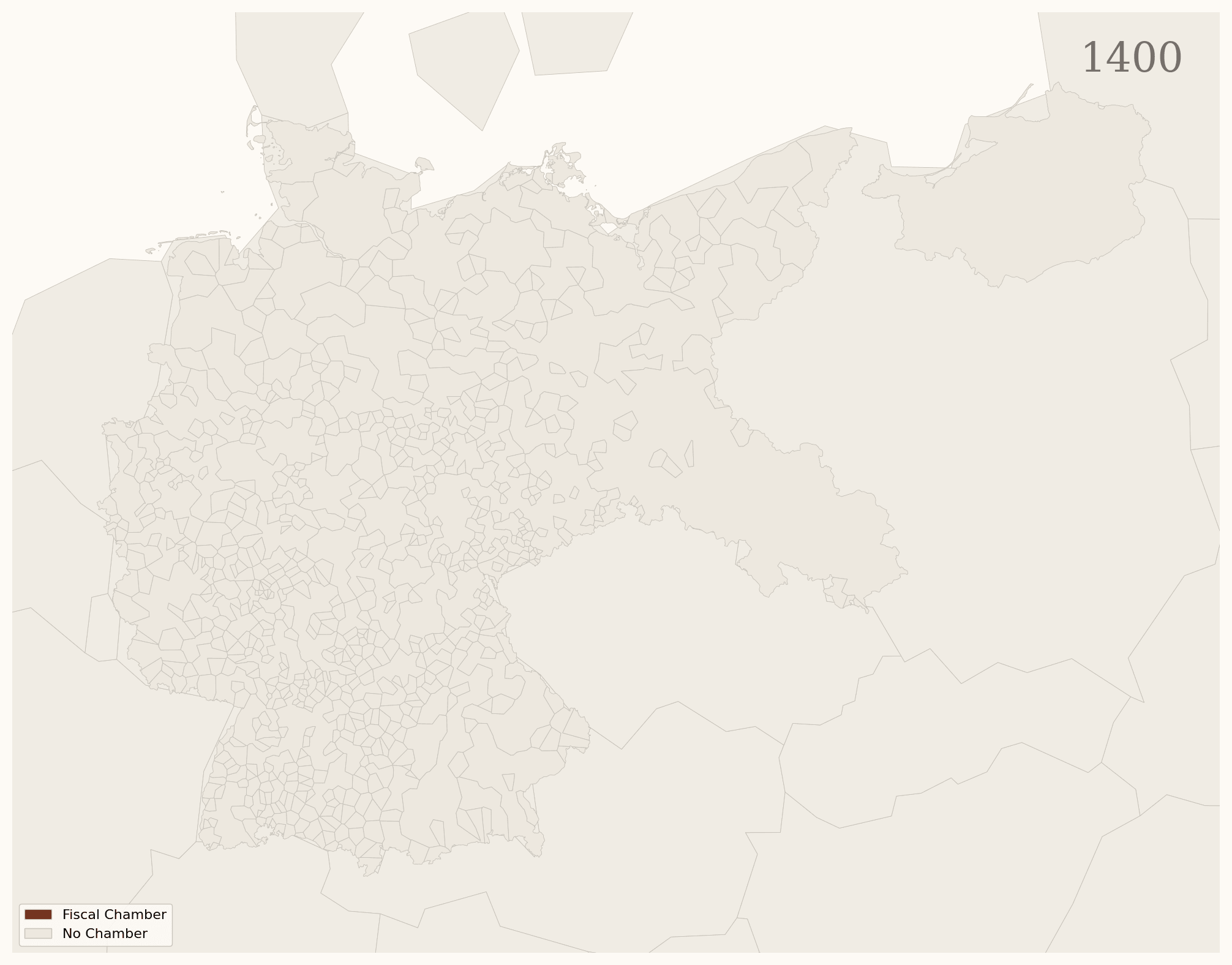
The Holy Roman Empire c. 1400: over 300 territories, none with centralized fiscal administration.
The Innovation: Chambers
The reform took the form of the Kammer, a fiscal chamber. A permanent office, staffed by salaried officials, with one job: collect revenue, record it, and account for it. Not the prince’s household servants managing the treasury between banquets. Not tax collection farmed out to the highest bidder. A proper bureaucracy.
Württemberg established the first chamber in 1521. Over the following two centuries, 38 other territories in the sample followed. The map below shows the Empire by 1700, when the reform had spread across much of the north and centre.
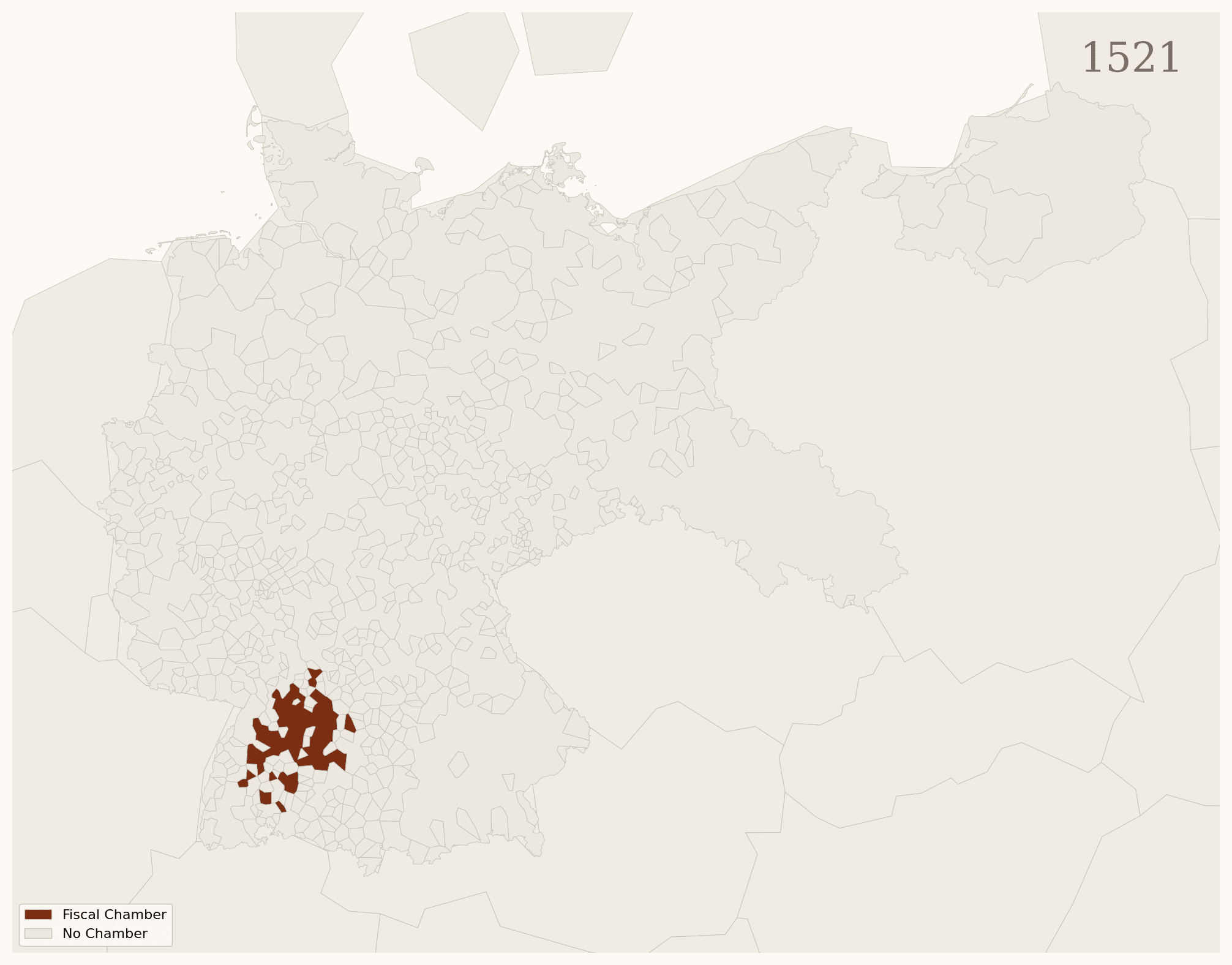
The Empire in 1521, the year Württemberg established the first fiscal chamber (shown in sienna).
What drove adoption? The Imperial Diet levied taxes at irregular intervals to fund campaigns against the Ottomans. The timing and size of these levies were quasi-random from a territory’s perspective. Territories with a larger tax burden had a stronger incentive to adopt chambers, because the efficiency gains from better bookkeeping scaled with the amount to be collected. Cantoni, Mohr, and Weigand exploit this as an instrument for causal identification.
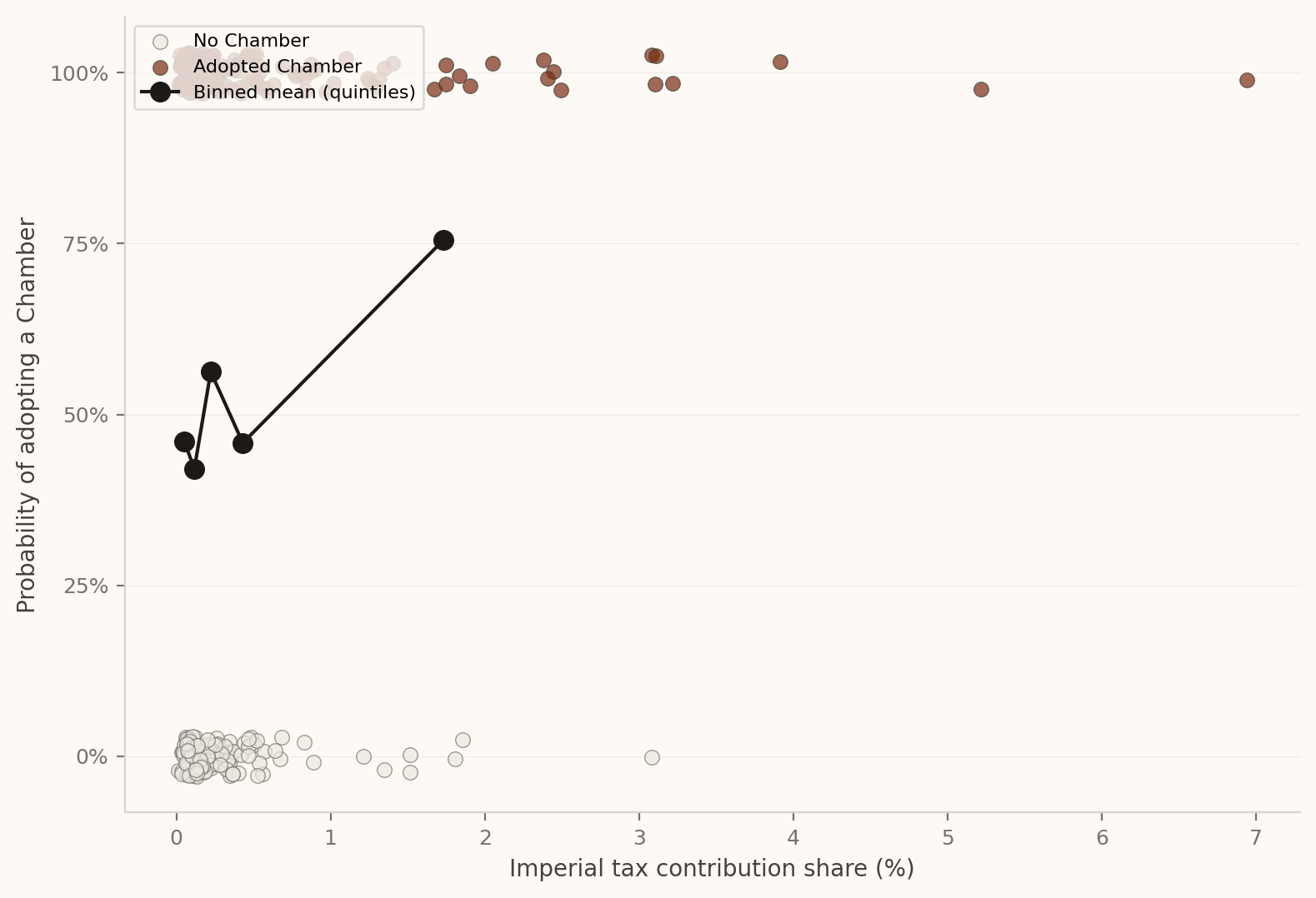
Territories with larger Imperial tax contributions were more likely to adopt fiscal chambers. Binned means (quintiles) shown in black. Only territories with non-zero contribution share included.
What predicts Chamber adoption? (Table I)
Panel regression at the territory-decade level. The dependent variable is whether a territory adopts a Chamber in a given decade. Geographic, internal power, commercial, and pressure variables are jointly insignificant. Only the Imperial tax contribution is a strong predictor.
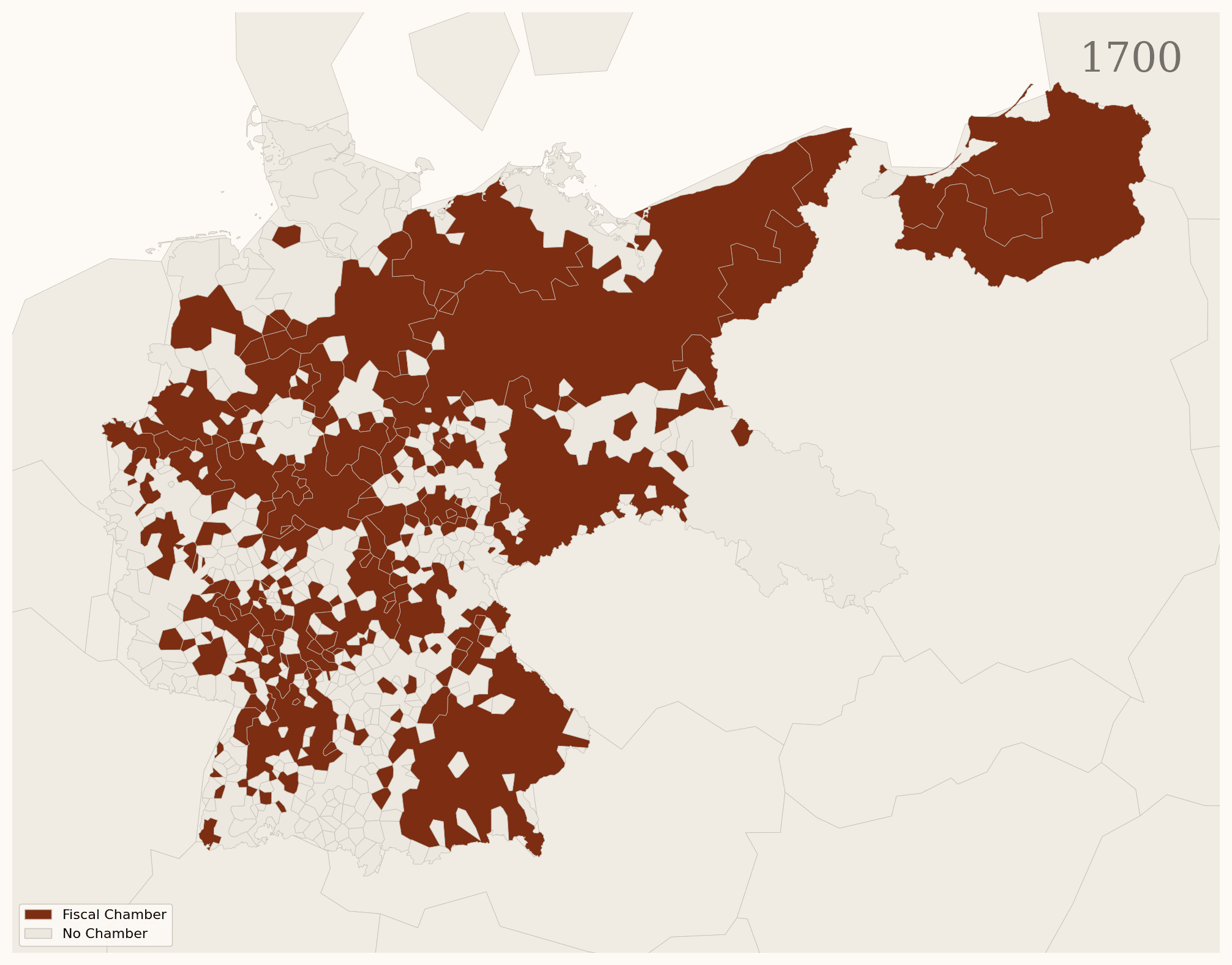
By 1700, the majority of large territories had adopted chambers. The contrast between centralized and non-centralized territories is visible.
The Empirical Strategy
The core specification is a difference-in-differences design at the territory-year level. The treatment is binary: whether territory j has adopted a fiscal chamber by year t. All regressions include territory and year fixed effects and cluster standard errors at the territory level.
The identifying assumption is that, conditional on territory and year fixed effects, the timing of chamber adoption is uncorrelated with unobserved determinants of territorial consolidation. The event studies below test this directly: if the assumption holds, pre-treatment coefficients should be indistinguishable from zero.
Two concerns about endogeneity deserve attention. First, territories that adopted chambers may have been on a pre-existing growth trajectory. The event studies address this. Second, the size of Imperial tax levies may have been influenced by territory characteristics. The authors use a shift-share instrument: the interaction of a territory’s fixed contribution share (from the 1521 Imperial Register) with the time-varying total tax size. The fixed share is predetermined; the total is driven by Imperial military needs, orthogonal to individual territory conditions.
Survival
The first test: did territories that adopted chambers survive? Between 1400 and 1800, roughly half of all territories vanished. The event study tracks what happened after adoption. Pre-treatment coefficients are flat, confirming that chamber adoption was not driven by pre-existing survival advantages. Post-treatment, the gap opens and compounds over decades.
Survival regressions (Table II)
Growing Larger
Territories with chambers did not just survive. They expanded. The measure is the log number of cities under direct control. The event study reveals a steady, cumulative divergence: by the tenth decade after adoption, treated territories controlled roughly twice as many cities as the counterfactual.
This was not conquest in the dramatic sense. Rather, it was the compound interest of better administration. A territory that could collect revenue reliably could maintain garrisons, settle legal disputes in its favour, and attract the allegiance of smaller neighbours who preferred a competent overlord to an incompetent one.
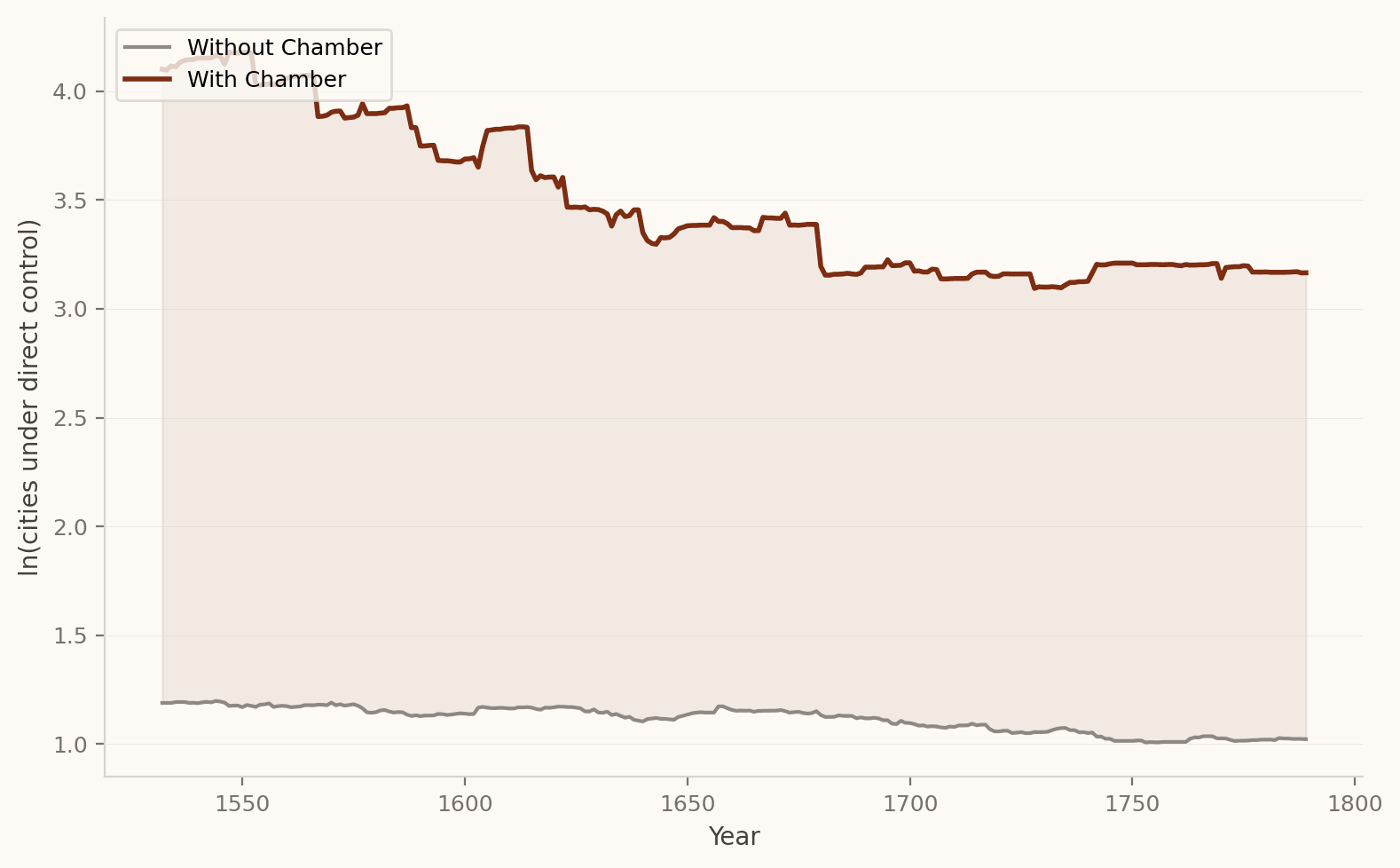
Raw mean territory size (log cities) by treatment status. The gap between centralized and non-centralized territories is large and persistent. Note: this is a naive comparison; the event study below adjusts for fixed effects.
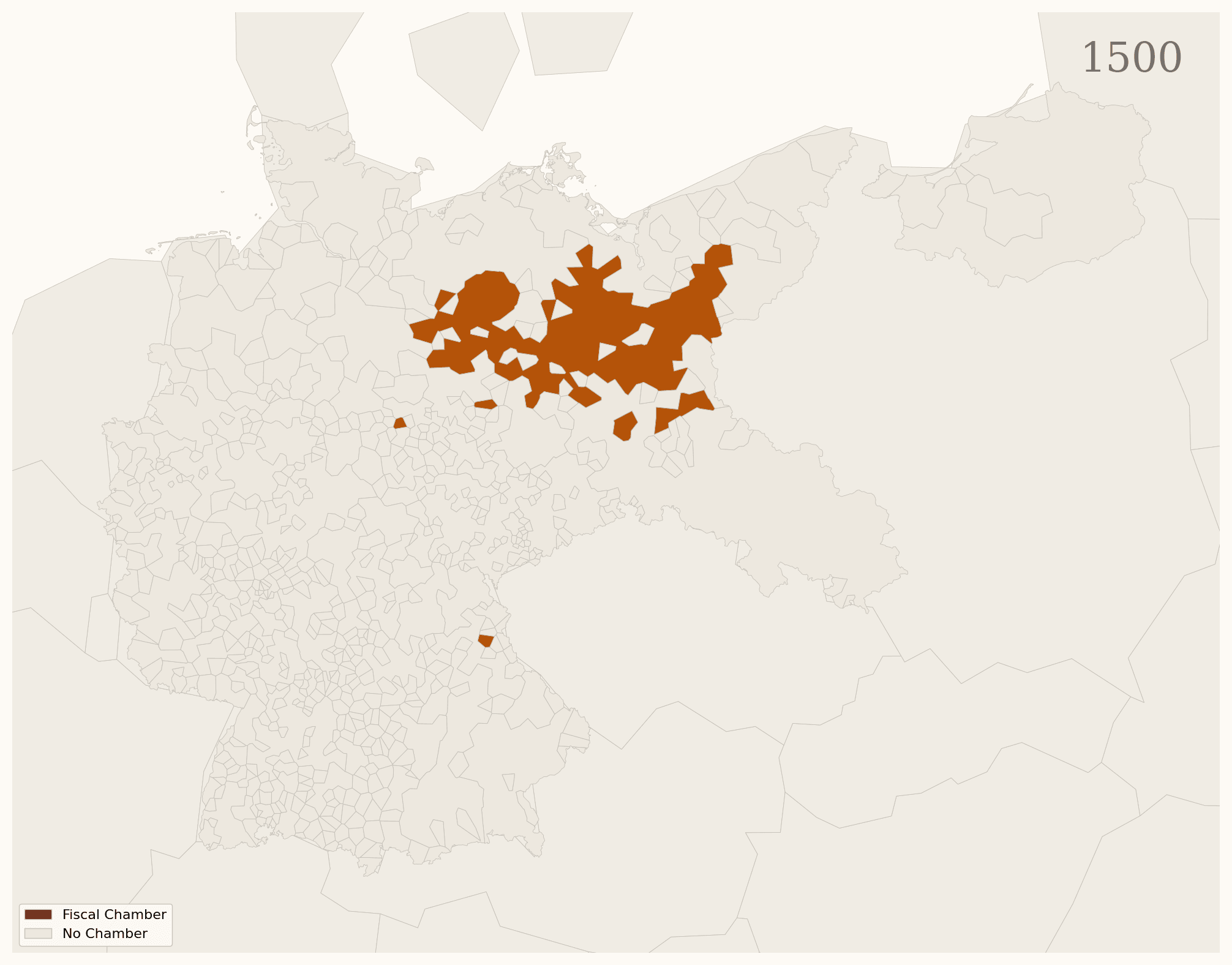
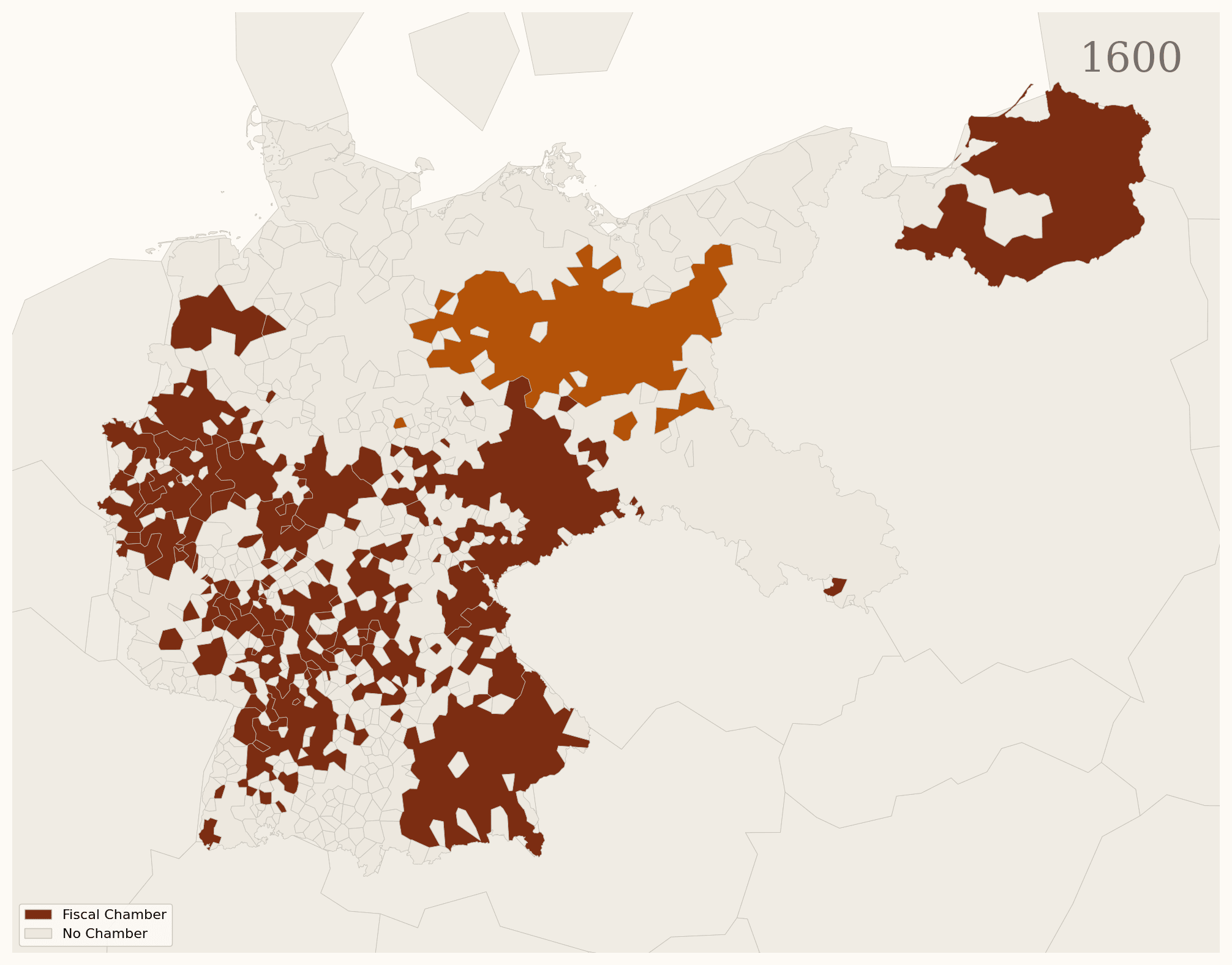
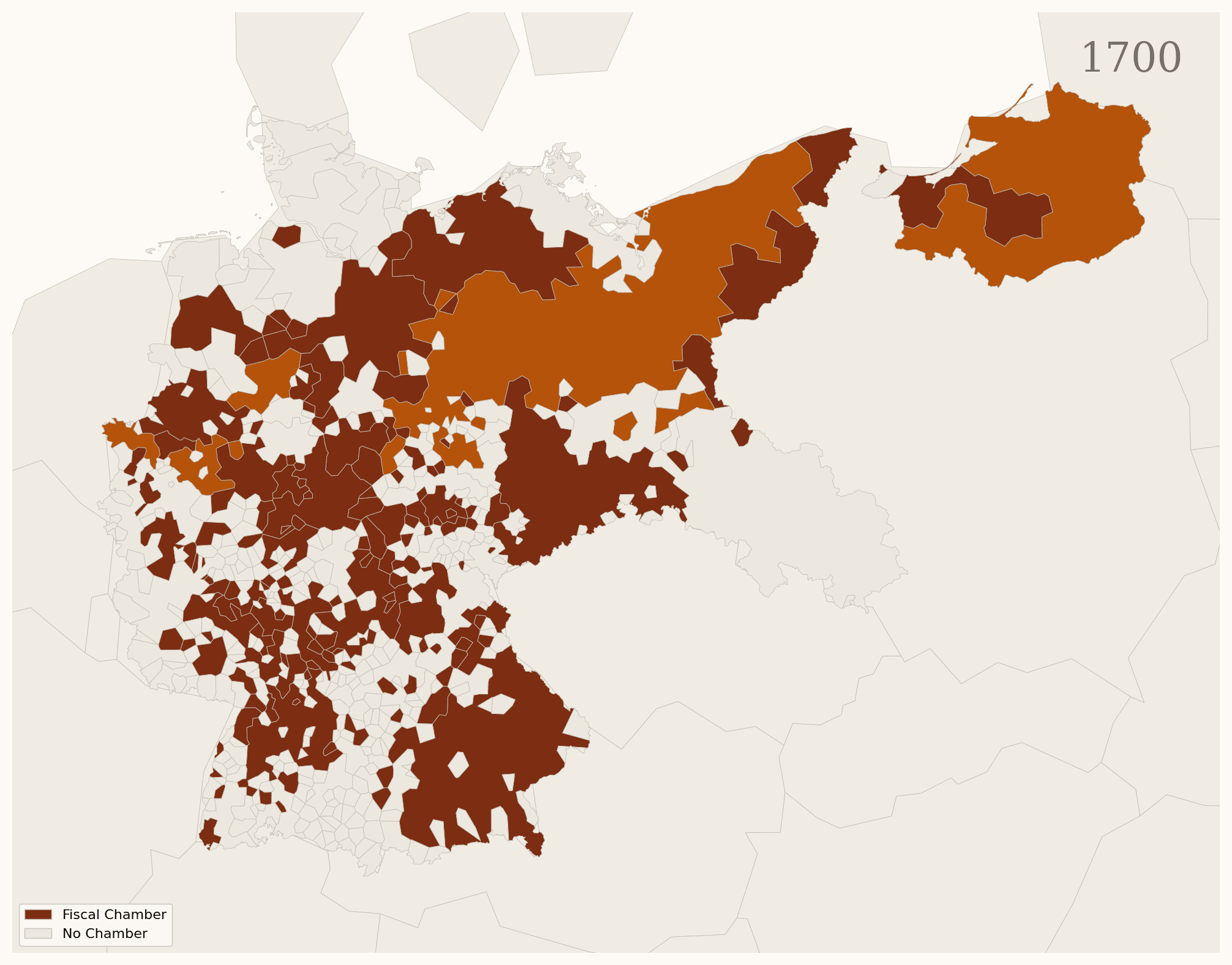
Brandenburg illustrates the mechanism. After establishing a chamber in 1577, the Margraviate expanded steadily through purchase, inheritance, and strategic marriage. The maps below show its territorial growth across a century.
1500
1600
1700
Territory size regressions (Table III)
Rounding the Borders
Medieval territories were not tidy shapes. They were sprawling, fragmented collections of holdings: a castle here, a village there, a toll station on a river fifty miles away. The measure of consolidation used here is the share of a territory’s total border length that consists of internal (own-territory) borders rather than boundaries with foreign neighbours. The event study shows that chamber adoption led to steadily more compact territories, reaching nearly six percentage points by the tenth decade.
Follow the Money
How did chambers produce these effects? They collected more revenue. In Hesse, revenues increased by more than 50% within a decade of the chamber’s establishment in 1546. In Albertine Saxony, the chamber (1524) turned a volatile revenue stream into a steadier upward trajectory.
The mechanism was not higher tax rates but better collection. Medieval princes lost enormous sums to embezzlement, poor record-keeping, and the inability to track what they were owed. Permanent offices with salaried clerks, standard ledgers, and regular audits plugged the leaks.
Revenue data from North (1999) for Hesse and Schirmer (2006) for Saxony. Vertical line marks chamber establishment.
The Marriage Network
Money bought more than armies. What ambitious princes did with their surplus, above all, was marry well. Dynastic marriages could bring territory, alliances, and claims to distant thrones. The network below maps marriage connections between ruling families. Each node is a ruler; each line a dynastic tie.
Centralized territories sit in the dense centre of the network, connected to more partners and more powerful ones. Territories without chambers cluster at the periphery. Toggle between snapshots: by 1700, many of those peripheral territories no longer existed.
Dynasty marriage network, c. 1600. Nodes sized by connections; sienna = centralized territory.
The Bigger Picture
The decisive advantage was not a battle or a monarch. It was a room full of clerks keeping accurate books. Chambers created the administrative capacity behind armies, marriages, and borders. The territories that adopted them earliest became the building blocks of modern Germany after the Empire dissolved in 1806.
The fiscal chamber, designed to concentrate princely power, also created the conditions for its limitation. Territories that taxed reliably faced demands for representation. The bureaucratic state, born of princely ambition, became in time the constitutional state, born of the subjects’ insistence that taxation required consent.
Cantoni, Mohr, and Weigand (2024) document the full causal chain. This page replicates their core findings in Python from the published replication package (Zenodo, doi:10.5281/zenodo.13141937). The regressions, event studies, and maps are computed directly from their data.
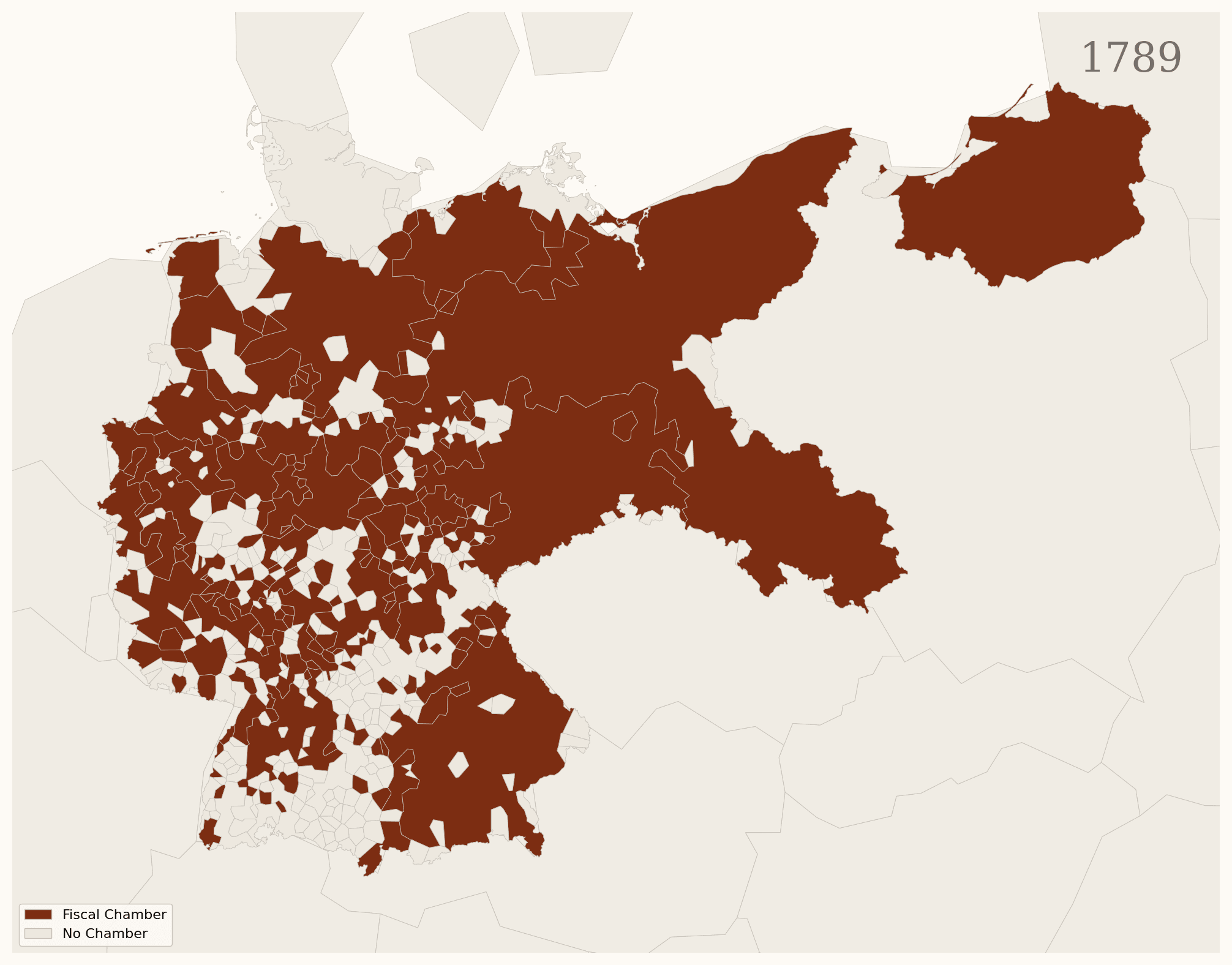
The Empire in 1789, on the eve of the French Revolution. The consolidation is visible: fewer, larger territories, most of them centralized.
Explore the Data
Drag the slider through four centuries of state formation, click territories for details, and interrogate the regression specifications that underpin the findings.