The Hegemon's Dilemma
Why hegemonic extraction is self defeating

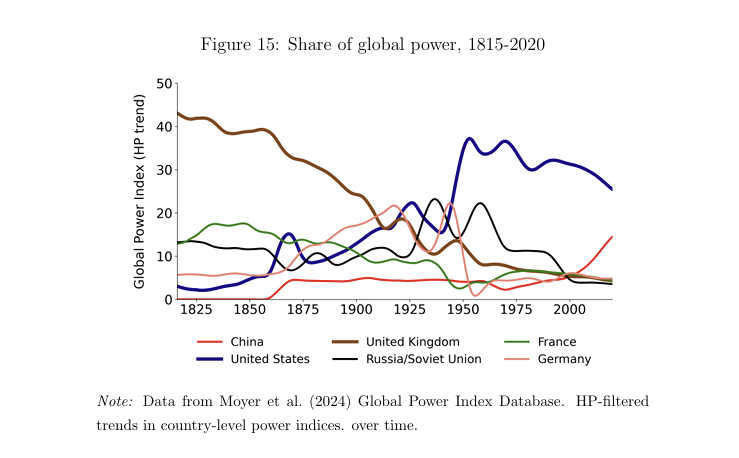
The paradox of contemporary American statecraft invites careful examination: Washington deploys increasingly severe economic instruments yet finds its relative position eroding rather than strengthening. The Trump administration introduced transactional diplomacy at unprecedented scale, escalating from negotiation to leverage, and from leverage to extraction, until diplomacy became little more than bullying. Still, the gap separating American and Chinese capabilities continues to narrow toward levels reminiscent of interwar multipolarity, as Broner et al. (2025) document. Beijing is leading the trade war by points. European allies pursue autonomy despite security dependencies. India, essential to any future global architecture, found itself unexpectedly subject to tariffs. The Global South observes these dynamics, recalibrating accordingly. The pattern hints at something deeper than tactical miscalculation of the hegemon: coercion may deliver immediate compliance while eroding the conditions for its future exercise.
Clayton, Maggiori, and Schreger (2025) provide formal grounding for this intuition. In single interactions, coercive power grows when hegemons damage what targets receive through exit, or lowering the “outside option” in game-theoretic terms. In repeated games, however, negative threats damage both immediate payoffs and future expectations simultaneously. Targets recognize that compliance today preserves vulnerability tomorrow, while resistance, if weathered, promises reduced exposure going forward. The logic inverts: defection grows increasingly attractive precisely because coercion teaches its own escape. Each sanctions episode becomes an inadvertent tutorial in diversification, transforming tactical compliance into strategic realignment.
This self-undermining quality of coercion echoes through economic history. Keynes perceived it in the Versailles reparations, observing how excessive extraction destroys the productive capacity it seeks to harness. Hirschman documented how Nazi Germany weaponized trade dependencies with Eastern Europe, deliberately concentrating smaller economies’ trade flows to create political leverage, yet later admitted overlooking the countertendency that destabilizes such dominance. His insight came three decades after his initial analysis: asymmetric dependence generates asymmetric focus. For the subordinate partner, escape becomes existential; for the dominant one, maintaining control remains merely one priority among many. The energy devoted to achieving autonomy systematically exceeds that invested in preventing it. Both theorists glimpsed fragments of a larger pattern, yet neither fully formalized how power accumulation creates the conditions for its own erosion.
Hegemonic Globalization
Broner et al. (2025) reconceptualize hegemonic power through an economic rather than military lens: size creates attraction, and attraction enables influence. Countries align not from fear of punishment but from the magnetic pull of economic opportunity. This reframing proves essential for understanding both accumulation and erosion of power. Their framework rests on recognizing that policy harmonization reduces trade frictions. When nations align regulatory standards, investment protections, or market structures with a hegemon, they facilitate exchange not merely bilaterally but throughout the aligned network. Each additional participant amplifies the returns to alignment for all others which forms a network multiplier that transforms voluntary cooperation into self-reinforcing integration. Countries with divergent preferences may still find alignment optimal once critical mass develops. The gains from network participation overwhelm the costs of policy deviation, creating an equilibrium where globalization persists despite leaving some participants worse off in absolute terms. Those proximate to hegemonic preferences capture substantial benefits; those distant suffer losses yet remain bound by the prohibitive costs of exit.
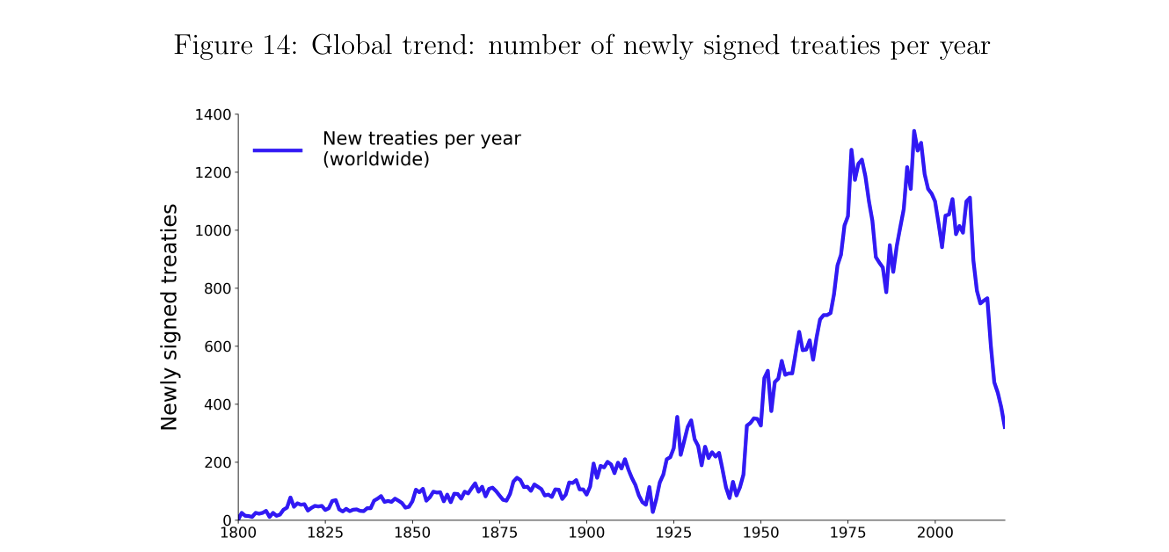
Broner et al. document empirically that 1945-2000 saw an explosion of treaty-signing activity, particularly in Western Europe, that preceded the expansion of trade. Treaties on economic cooperation, investment protection, transportation, and regulatory standards created the infrastructure for deeper integration. Kindleberger (1986) captured this through his public goods framework, where the hegemon provides open markets during crises, stable currency systems, and security guarantees that enable others to prosper. The Marshall Plan exemplified such “heroic” provision, creating conditions where alignment delivered mutual benefit rather than zero-sum extraction.
Yet within this voluntary architecture lies asymmetric vulnerability. Hirschman demonstrated in 1945 how differential exit costs generate leverage: disruption that proves catastrophic for smaller economies registers as mere inconvenience for larger ones. The same networks that enable prosperity through integration become instruments of coercion through selective exclusion. What Hirschman failed to anticipate—and later acknowledged as his analytical blind spot—was how this very asymmetry triggers its own reversal through differential attention. The dependent party focuses relentlessly on escape while the dominant one divides attention across multiple concerns.
CMS’s formalization helps to understand how these elements interconnect. The bundling of relationships, or what they term “joint threats”, magnifies both the benefits of participation and the costs of exit. Golden handcuffs emerge: the opportunity cost of leaving an interconnected ecosystem becomes prohibitive even when terms deteriorate. Yet this same architecture that makes voluntary alignment irresistible during phases of provision enables coercive extraction later.
Suffering from Success
The provision of international public goods faces a classic free rider problem. When hegemons maintain open markets through downturns, stabilize currency systems, or enforce rule-based trading regimes, smaller nations capture benefits without sharing costs. Kindleberger diagnosed the resulting instability: “The leader becomes tired of free rides, or believes he or she is being bankrupted by excessive burdens.” This structural asymmetry fuels economic nationalism. Populist movements articulate what amounts to a rational bargaining constraint: domestic electorates resist subsidizing a global order that accelerates rival ascent. As challengers benefit disproportionately while contributing minimally, domestic politics demands the hegemon convert accumulated leverage into tangible extraction.
This political pressure converges with strategic recognition. The hegemon perceives that its era of investment has created dependencies ripe for harvest. Decades of provision have generated interdependencies so deep that not exploiting them appears strategically negligent, particularly when facing rising competition. The architecture reveals its dual nature: instruments designed for public goods provision function equally well for extraction. The infrastructure remains constant; only its application shifts from positive to negative.
CMS formalize power through the participation constraint: the differential between what countries receive within relationships versus through exit. Power equals inside option minus outside option. The wider this gap, the more hegemons can extract before targets choose defection. Exit means forfeiting access not merely to the hegemon but to entire constellations of aligned partners.
Two instrument categories exploit these constraints. Positive threats enhance the inside option: hegemons provide benefits (aid, technology, market access) then extract equivalent policy alignment. Negative threats diminish the outside option: hegemons inflict damage through sanctions, export controls, financial exclusion, or supply chain disruption. In static analysis, these appear equivalent. Both widen the inside-outside differential identically, generating identical coercive capacity in single interactions.
Repeated interactions shatter this equivalence. With positive threats, hegemons provide benefits worth +1 while extracting compliance worth -1. Targets’ flow utility remains neutral: gains equal losses. Crucially, future expectations remain stable. The hegemon has merely created and captured value in equal measure, leaving future power intact. Negative threats function differently. When hegemons damage outside options, flow utility declines immediately. But targets perceive something more significant: refusal today reduces tomorrow’s vulnerability. The outside option’s degradation signals exploitation willingness, diminishing expected future value. Continuation values decline alongside flow utility. As CMS observe, “threats against the outside option are in part self-defeating in a repeated game.” This dynamic divergence exposes coercion’s inherent instability. Each negative threat demonstrates exploitation risk, making defensive investments (diversification, domestic capacity building, alternative partnerships) increasingly rational. Yet comprehending why coercion proves inadequate requires examining not merely this dynamic problem but also deeper structural limits.
Degradation through Coercion
Within relationships, CMS demonstrates systematic tightening of participation constraints. When negative threats diminish outside options, continuation values decline because targets recognize that today’s compliance preserves tomorrow’s vulnerability. This generates an intertemporal wedge: while the inside-outside gap may remain stable in flow terms, anticipated future exploitation reduces the present value of staying aligned. CMS show how targets respond through structural adjustments: cultivating new suppliers to expand input variety, restructuring production away from hegemon-controlled inputs, and investing to enhance alternative suppliers’ productivity. Since damage from losing any input depends on expenditure shares and alternative availability, these defensive investments progressively reduce vulnerability to future threats.
Across relationships, Broner et al. highlight a different, potentially more binding constraint. Their model reveals how network effects generate discontinuous alignment shifts. With a single hegemon, countries align despite policy divergence because bilateral alignment enhances trade with all aligned nations. The network multiplier overwhelms utility losses from adopting unfavorable policies. Yet this multiplier operates symmetrically: once rivals achieve sufficient scale, their network value can exceed the incumbent’s. The mechanism resembles coordination games with strategic complementarities where attraction basins shift discontinuously at critical thresholds.
Each bilateral relationship weakened through repeated coercion diminishes the incumbent network’s aggregate value, lowering thresholds for systemic realignment. Meanwhile, emerging alternative networks facilitate the structural adjustments CMS describe. Targets’ capacity to develop alternatives and enhance their productivity depends partly on whether viable alternative networks exist for sourcing.
This synthesis suggests why transitioning from positive to negative threats may initiate irreversible decline. Positive threats preserve both continuation values and network cohesion. Negative threats appear to erode both simultaneously, creating compound effects where bilateral degradation and network fragmentation reinforce each other. Hegemons confront what might be termed an intertemporal trap: deploying accumulated leverage generates immediate returns while potentially accelerating both individual participation constraint tightening and approach toward systemic reversal. Once initiated, returning to positive threats may prove insufficient if trust and production structures have already adjusted beyond recovery thresholds.
Time-Inconsistency
The optimal strategy for sustaining hegemonic power appears straightforward: maintain positive threats and public goods provision indefinitely. Kindleberger termed this “leadership through provision,” where power derives from making systems valuable rather than extracting from them.
Three barriers prevent this equilibrium. First, the fiscal constraint. Public goods provision demands sustained expenditure on defense, market stabilization, and crisis management. These costs concentrate domestically while benefits diffuse globally, creating political economy problems where voters observe costs but not returns. Second, the free-rider problem intensifies as challengers expand. Rising powers capture disproportionate gains from hegemonic provision without contributing to maintenance costs.
Third, and most fundamentally, time-inconsistency renders restraint dynamically unstable. Consider the hegemon’s optimization at different junctures. Ex-ante, before interdependence exists, perpetual restraint appears optimal. The present value of maintaining voluntary alignment indefinitely exceeds any finite extraction path triggering degradation. But ex-post, after interdependence has been constructed, this changes. The hegemon now confronts accumulated leverage where participation constraints bind loosely. Immediate gains from tightening these constraints through extraction exceed discounted future degradation costs, particularly given political discount rates privileging current benefits.
The commitment problem proves intractable because hegemony and institutional constraint are mutually incompatible. The hegemon’s defining characteristic is its position above institutional orders: it provides enforcement making institutions function, funds organizations coordinating policy, and supplies security enabling economic integration. Like Schmitt’s sovereign who decides on the exception, the hegemon cannot be meaningfully bound by the system it guarantees. Any institution powerful enough to prevent hegemons from exploiting accumulated leverage would necessarily constrain their ability to provide public goods, negating hegemonic function. Even self-imposed constraints fail as future governments cannot bind themselves to current commitments, particularly when national security justifications can override institutional restrictions.
Extractive Hegemony
The distinction between inclusive and extractive institutions, developed by Acemoglu and Robinson for domestic contexts, illuminates hegemonic dynamics. Hegemons can be understood as institutional constellations encompassing both domestic capabilities and international architectures like multilateral organizations, financial infrastructure networks, technical standards bodies, and supply chain control points.
Inclusive hegemonic institutions correspond to voluntary alignment where countries join because network effects generate positive-sum gains. Systems create value exceeding what bilateral relationships alone would provide. Hegemons provision public goods and alignment increases everyone’s trade opportunities. Extractive institutions reflect forced alignment, where countries remain trapped by network effects despite suffering welfare losses. Access to technology, finance, or trade becomes conditional on political compliance.
The parallel reveals critical inversion. Domestic extractive institutions discourage innovation because returns get expropriated, leading to stagnation. Hegemonic extraction stimulates innovation, but in rivals rather than participants. When critical capabilities become conditional on compliance, targets face powerful incentives to develop alternatives. Each coercive episode reveals precisely which capabilities require indigenous development. Extraction itself provides both economic necessity and political legitimacy for rival investment in technological independence. Coercion inadvertently directs rival investment toward exact capabilities enabling future exit.
The shift in global order is no longer speculative; the empirical record Broner et al. (2025) provide captures its distinct footprint. Most revealing is not recent trade barrier increases but the collapse in alignment preceding them. After two centuries where treaty-making generally tracked global trade expansion, creation of new international agreements abruptly fell in the early 2000s. While causality requires caution, the timing and magnitude of this decline, resembling collapses during 1914 and 1939, offer an interesting interpretation of the current moment. The stalling of formal alignment suggests that the network multiplier Broner et al. describe reached structural limits. It implies that for many nations, marginal benefits of further integration receded below policy deviation costs well before great power rivalry returned. In CMS’s language, this retrenchment signals visibly tightening participation constraints. The sudden halt in treaty signing indicates that the inside option, the value of joining hegemonic networks, no longer sufficed to induce further voluntary alignment. The hegemon confronts an impossible challenge: deploying accumulated leverage accelerates decline, yet restraint appears strategically irrational facing a rivals ascent. This constitutes the hegemon’s dilemma: not whether to exercise power, but recognizing that exercising it systematically erodes the foundations that created it. Coercion succeeds tactically while failing strategically, winning battles while losing wars for systemic influence. The architecture of power, built through patient provision, becomes the instrument of its own undoing.
Picture: Cäsar am Rubikon - Wilhelm Trübner (um 1880)
Literature
Acemoglu, Daron. 2012. Why Nations Fail: The Origins of Power, Prosperity, and Poverty. With James Alan Robinson.
Broner, Fernando, Alberto Martin, Josefin Meyer, und Christoph Trebesch. 2025. „Hegemonic Globalization“.
Clayton, Christopher, Matteo Maggiori, und Jesse Schreger. 2025. Putting Economics Back Into Geoeconomics. No. W33681. National Bureau of Economic Research.
Hirschman, Albert O. 1978. „Beyond Asymmetry: Critical Notes on Myself as a Young Man and on Some Other Old Friends“. International Organization 32 (1): 45–50.
Hirschman, Albert O. 2024. National Power and the Structure of Foreign Trade. 1. Aufl. University of California Press.
Kindleberger, Charles P. 1986. „International Public Goods without International Government“. The American Economic Review 76 (1): 1–13.